
Nicely summarised case study of the work Martin and I did with the European Training Foundation just recently. Check out the full post below...
Category: Alignment for Customer Services
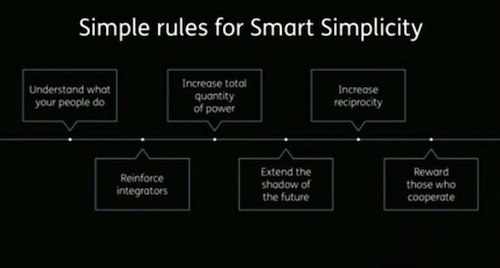
Could Smart Simplicity be the business model wave of the future?
As we’re warming up for the upcoming #responsiveorg event which will take place in London this May (come along if you’re not already signed up) I’m going to take a stab at collating some of the thoughts and approaches that might help us have a more productive time.
As you might expect, I’ll be coming at it from an alignment angle – yet, that is of course ultimately semantics. As a practical example, here’s a brief but interesting article that relates to what we call #ALIGN without directly using the word. Enjoy.

Follow the bouncing ball here:
1. The Fortune 500 was created in 1955; since then, you can argue that the business environment is six times more competitive + complex than it was.
2. As the complexity of a business has increased, most management philosophy still comes from 1911 (pre-WWI) and 1924 (the alternating “hard” and “soft” views of management). Different models have cropped up over time, including stuff like what Zappos is doing right now, but by and large, we see this situation playing out in many workplaces:
As they have responded to each new challenge, managers (as Taylor recommended) have introduced new structures, processes and systems. When this happens year after year, there is a damaging accretion of structural fixes — we estimate that the number of these has grown by a factor of thirty-five over the past 55 years. The consequence is what we call “complicatedness,”…
View original post 478 more words
 #alignyourorg