2017 03 #Eurocomm17 Reviewing The Past to Prepare for the Future

Top tweets from Adapt • Invent • Evolve: Reviewing the Past to Prepare for the Future @ #Eurocomm17

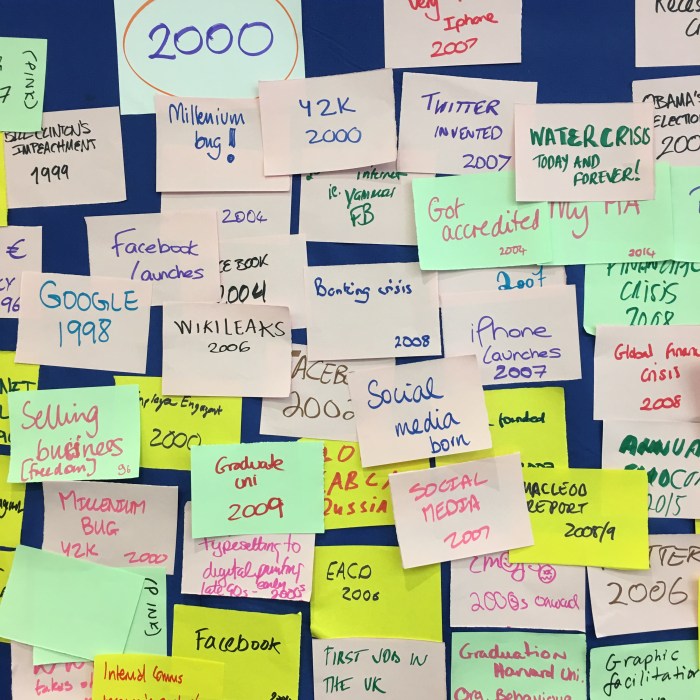
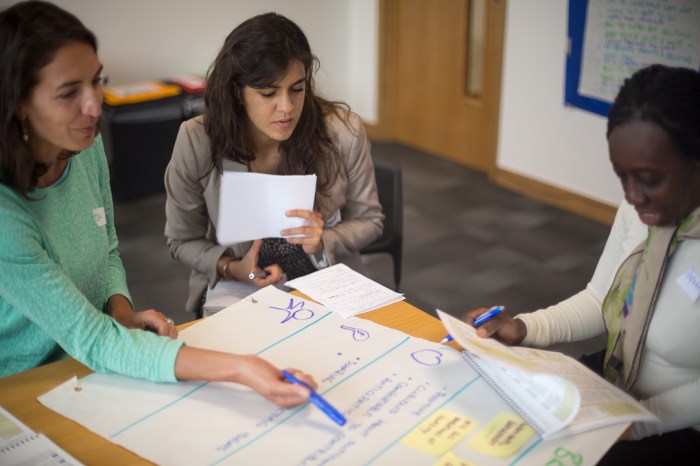
So excited to see @martingilbraith introducing a facilitated session for #eurocomm17 @IABCEME pic.twitter.com/2gjQVxSX6k— Kasha Dougall (@KashaDougall) March 28, 2017 //platform.twitter.com/widgets.js Facilitation Case study on ETF 20th anniversary - an IABC Gold Quill award winner #eurocomm17 pic.twitter.com/kBMZarnDhQ— Sharon Hunter (@SharonHunter) March 28, 2017 //platform.twitter.com/widgets.js And we're off - master facilitator @martingilbraith will show us how to … Continue reading Top tweets from Adapt • Invent • Evolve: Reviewing the Past to Prepare for the Future @ #Eurocomm17

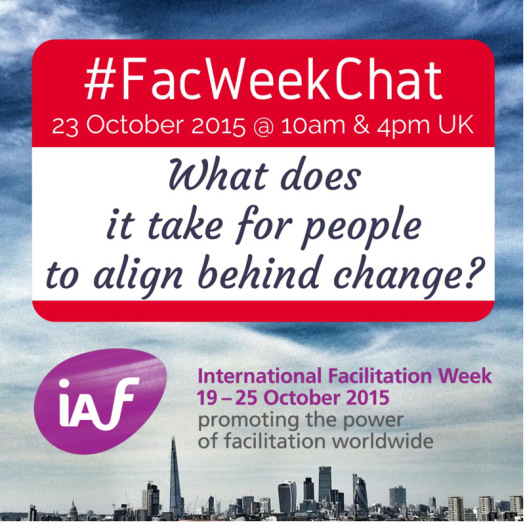
What does it take for people to align behind change?

This is the question that brought together 69 facilitation, communications and change management professionals over two one-hour twitter chats last October during International Facilitation Week - and Martin Gilbraith and I are now doing a follow-up for 2016 in the form of a webinar. During the session we will: invite you to share some of your own experience … Continue reading What does it take for people to align behind change?

An effective method to #alignyourorg

“How can I have more purposeful & productive conversations, bring out the wisdom of a group, encourage feedback between people, and reach shared awareness in meetings? How can I generate and weave together a diverse range of ideas, develop creative solutions and build a group consensus?” Here's our answer - skill up on your group … Continue reading An effective method to #alignyourorg

2012 08 08 Marcos Saboya and Gualter Pupo book maze @ RFH - picture by @michaelambjorn

Top reads for board members: daily, weekly, monthly and quarterly

A round-up of materials that can help you with your alignment work – this issue is focused on Alignment for the Boards but many of these insights apply across other areas of collaborative work. Daily If you're want realtime updates, then here are some useful and relevant organisations and hashtags active on Twitter: @EGBoard | @WOBUK | @tcbcorpgov | @SpencerStuart | @ClarksonCentre | @AICDirectors #board | #governance | #corpgov | … Continue reading Top reads for board members: daily, weekly, monthly and quarterly

Join me for my new series of free facilitation webinars in 2016!

Martin Gilbraith's avatarMartin Gilbraith

Are you interested to learn more about facilitation, and ICA’s Technology of Participation (ToP) methodology in particular – in a free, one-hour, interactive online session that offers an experience of virtual facilitation as well?

Please join me for my new series of free facilitation webinars!

Register now on Eventbrite for the first scheduled session (below), and register your interest on Surveymonkey for future dates & times and topics to be scheduled – scroll down for provisional dates & times and suggested topics.


ORID as a universal principle of facilitation 950x475Is there a single, universal principle of facilitation?

Monday 15 February, 13.00 GMT

This session will introduce a simple but powerful and versatile model, that can be applied as a tool and even as a guiding principle. It can help facilitators to engage and empower their groups with greater confidence and versatility, to better enable them to make the change that they are seeking in the world.  The session will be equally suitable…

View original post 561 more words

Women in Nonprofit Leadership

The SOS model – Self, Others, Sector – can be used by both men and women to align their work to their purpose.

mizmunkusairiguidestarorg's avatarGuideStar Blog

A couple of weeks ago, I had the privilege of speaking at Independent Sector’s annual conference in Miami, where I was invited to be the “young professional voice” on the panel, Gender Inequity in the Charitable Sector. When preparing for the panel, I reflected back on my own career, within and out of the nonprofit sector.

women in nonprofit leadershipL to R: Janine Lee, Mizmun Kusairi, Grant Oliphant, Peggy Outon during the panel

I’ve worked in investment banking in New York, investment management and foundation work in Malaysia, youth development in California, and now in nonprofit infrastructure at GuideStar.  Each of these experiences informed my perspective on how to navigate the workplace as a “young” woman of color (to clarify, I am a proud Gen-Xer!) And while I am not an academic or gender equality expert, over the years, I’ve benefitted greatly from the advice of others, including my own trusted mentors, as…

View original post 1,009 more words

2012 08 08 Marcos Saboya and Gualter Pupo book maze @ RFH - picture by @michaelambjorn

What we’re reading: the latest on alignment for the Third Sector

A round-up of recent materials that can help you with your alignment work - this issue is focused on Alignment for the Third Sector but many of these insights apply across all sectors. A new guide to the Chair-CEO relationship is out A Question of Balance – a guide to the Chair and Chief Executive … Continue reading What we’re reading: the latest on alignment for the Third Sector

#FacWeekChat sunset

What does it take for people to align behind change? Six top tips & tools from #FacWeekchat

#FacWeekChat 2015Repost from Martin Gilbraith

This is the question that brought together 69 facilitation, communications and change management professionals over two one-hour twitter chats on October 23, during International Facilitation Week. In this post I’ll share six top tips and some of the tools that were shared in response.

The twitter chats were co-hosted by Michael Ambjorn of the International Association of Business Communicators (IABC), Faith Forster of the Change Management Institute (CMI) and myself for the International Association of Facilitators (IAF). Our aims were to bring people together to connect with and learn from each other on a topic of mutual interest, and also to make connections and foster broader collaboration between our associations and between our professions.

Participants were located as far afield as Canada, USA, Serbia, UK and India. Our experience of change included local and international work with large and small organisations in a variety of sectors and industries including health, education, IT, faith and international aid & development.

So what did we learn? What does it take for people to align behind change?

1. The context must be conducive. People align behind change “when external pressures have made the need for change evident”.  “The facilitator as midwife can only help a client that is already pregnant”!

2. High level vision and goals, and ideally values as well, must be clear and shared. Alignment happens when there is “a clear purpose… before a decision on what to do, a focus on energy & momentum for change”.

3. There must be inclusive and authentic participation. “Holistic participation in co-creating vision is the key to create buy in”.  “Co-design, co-creation, collaboration”. “Convene all with a stake in change”. “Everyone wants change, but no-one wants to be changed”.  Alignment does not happen “when when people forget that changes requires the involvement of others” or “when change is imposed from above without proper consultation or facilitation”.

4. Humility, patience and deep listening is required. “Be honest and transparent about the challenges that will be faced, otherwise when failure happens you lose people’s trust”. “Take time, constant process checks, take time, listen, take time, acknowledge resistance (did I mention take time?)”. “Come to terms with the antibodies in the system and talk candidly about them”. “The disruptive power of good listening skills”. “Pay as much attention to the intangibles amongst people as to what is explicitly being said”.

5. Be open to what needs to emerge, while remaining focused on the vision. “Start with possibilities rather than a project plan” and “be aware of groups emerging needs… [allow] the group synergy to flow”.  Alignment did not happen “when people didn’t respond to emerging needs, and when personal issues took precidence over common vison”.

6. Nevertheless, leadership must also be be clear, decisive and inspiring. “Be a leader that makes tough decisions. The notion of change is disruptive, but strong leadership can mitigate people risk”. Make a “powerful invitation, expressed openly with integrity”. “Discussions about change are so often are negative, ie. about failure – we need to inspire people, enable them”.

What tools and techniques can help?

Favoured approaches to addressing the challenges of aligment and change included the Art of Hosting/Art of Participatory Leadership, Organisational Development, Quality Management, Coaching and Mediation, Graphic Facilitation (especially in multilingual contexts), the work of Perry Timms on ‘hacking adaptable organisations’ and of course ICA’s Technology of Participation (ToP).

Some of the particular tools referenced were Story Boarding and Lead with a Story, My Goals My Action Steps, Power/Interest Matrix, RASCI, Ladder of inference, CSITO’s Constellation Collaboration model and the ToP Focused Conversation method.

What can we learn from each other?

What can communications and change management professionals learn from facilitation? “If you want to bring people with you you have to involve others, and facilitation is a great way to do that”. Facilitation “can help transform communications ‘from cascade to conversation’” – “communicators can learn from facilitators about how to structure conversations once people are engaged”. “Change management can get caught up in project management processes – facilitation keeps the focus on what is important”. “At a simple level, facilitation can help managers learn to run more productive and enjoyable meetings”.

What can facilitators learn from communications and change management? How “to get people ‘in the room’ for facilitation, to engage all those who will never be ‘in the room’… and to communicate the results”.  Also “good use of data gathering tools”, “ways to measure/evaluate the outcomes of their facilitation work” and how to “draw out stories as they relate to the task at hand, and use these stories for sense making”.

We could all benefit from each other’s professional standards and competency models – IAF’s Facilitation Core Competencies, IABC’s communications Global Standard andCMI’s Change Management Foundation & Master Competencies.

For more of what we shared, including links to many of the examples and tools referred to, see the edited highlights on Storify or find all 707 tweets at #FacWeekchat on Twitter.

 

Martin Gilbraith's avatarMartin Gilbraith

#FacWeekChat 2015This is the question that brought together 69 facilitation, communications and change management professionals over two one-hour twitter chats on October 23, during International Facilitation Week. In this post I’ll share six top tips and some of the tools that were shared in response.

The twitter chats were co-hosted by Michael Ambjorn of the International Association of Business Communicators (IABC), Faith Forster of the Change Management Institute (CMI) and myself for the International Association of Facilitators (IAF). Our aims were to bring people together to connect with and learn from each other on a topic of mutual interest, and also to make connections and foster broader collaboration between our associations and between our professions.

Participants were located as far afield as Canada, USA, Serbia, UK and India. Our experience of change included local and international work with large and small organisations in a variety of sectors and industries including…

View original post 721 more words

#FacWeekChat sunset

What does it take for people to align behind change? Experts from around the world share their thoughts…

Following the recent #FacWeekChat which Martin Gilbraith, Faith Forster and I co-hosted - here's the Storify - kindly collated by Martin.